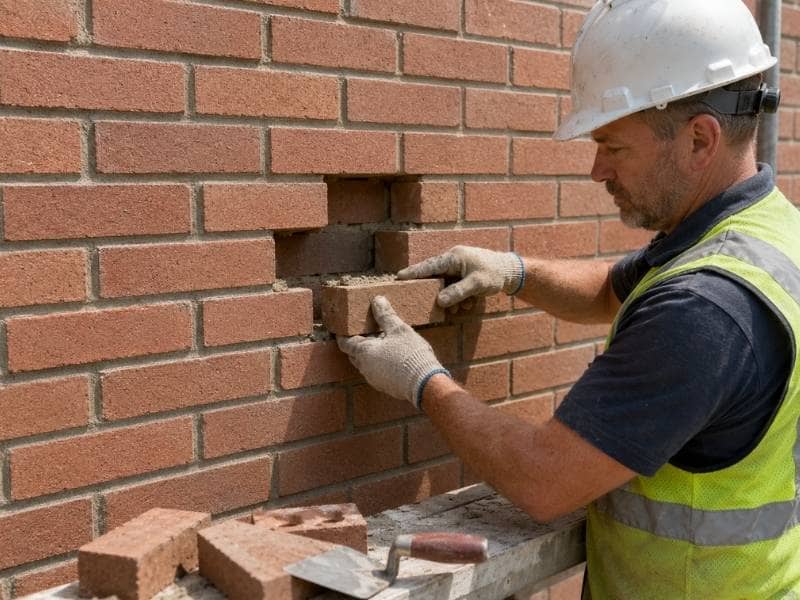
A crack keeps widening between the same two courses, or a patch of brick bulges out from the rest of the wall. A professional brick mason has to decide whether fresh mortar will fix it or whether that section needs to come apart and go back together. Repointing works when the bricks are sound and only the joints have worn. Once the brick has lost its bond or the wall has shifted out of line, packing in new mortar just hides the problem. This article explains how a mason tests the wall, identifies signs that repointing will not hold, establishes the limits of a rebuild, and puts the section back together so the same failure does not return. Knowing the difference helps you plan the right repair the first time.
How a Brick Mason Tests Whether the Bricks Are Still Secure
A brick mason starts a repair by finding out how much of the wall still holds together. Repointing only replaces worn mortar between sound bricks. So the first job is to learn whether the problem stops at the joint surface or reaches into the brick itself.
The mason presses and taps individual bricks to feel for movement. A brick that rocks, shifts or sounds hollow has lost its grip on the mortar around it. One loose brick near the surface is often a small fix. Several loose bricks across the same area point to a bigger problem the joints alone can’t solve.
Next comes a look at the joints and the courses nearby. Shallow erosion, where only the outer face of the mortar has worn away, usually calls for repointing. Deeper trouble shows up when bricks on either side of a joint have pulled apart, or when a whole row has drifted out of line. At that point the bond is failing, not just the mortar face, and repointing won’t bring it back.
When Deep Mortar Deterioration Makes Repointing Insufficient
Mortar can fool you. The face of a joint might look crumbled and soft while the mortar an inch back stays firm and tight. That kind of surface wear is normal, and it’s exactly what repointing is built to fix. The mason rakes out the soft outer layer and packs in fresh mortar against the sound material behind it.
The picture changes when the damage runs most of the way through the joint. If the mason rakes into a joint and keeps hitting loose, sandy or empty space, there’s little solid mortar left to build against. Fresh mortar needs something firm to bond to and press against. Pack it into a joint that’s hollow all the way back, and it has nothing to hold it in place.
Once too much of the joint depth is gone, repointing turns into a patch that won’t last. The wall may hold for a season, then loosen again as the weak core keeps giving way. When a mason finds deep, widespread mortar loss across a section, taking that section apart and rebuilding it is the repair that holds.
Wall Movement That Requires Bricks to Be Removed and Reset
Some walls have a problem that fresh mortar can’t touch. A section may bulge outward, lean to one side or show bricks that have slipped out of their row. Cracks that keep widening between courses are another clear sign. All of these mean the masonry has shifted away from where it was built to sit.
Repointing swaps out old mortar for new. It does nothing to move a brick back into place. A leaning or bulging wall is already out of alignment, and packing new mortar into the joints just locks the crooked shape where it is. Worse, it can hide the movement for a while and let it keep going out of sight.
That’s why a mason treats real movement as a rebuild trigger, not a repointing job. To straighten a bulged or leaning section, the bricks have to come out and go back in true. There’s no way to reposition a wall from the joints alone. The moment a section has clearly moved, the fix means removing the affected brick and resetting it.
How a Brick Mason Establishes the Limits of the Rebuild
Before any brick comes out, the mason decides how far the rebuild has to reach. The goal is simple. Remove the damaged masonry until you reach brick and joints that are still firm, still in line and still bonded to the wall. The rebuilt section then ties into solid work on every side.
This often means the repair area is larger than the damage you can see. Loose or shifted brick at the edge of a failure won’t give a stable base for new work. If a mason rebuilds right up against a brick that’s already half-detached, the new section has a weak seam built into it from day one. Cutting back to sound brick makes the finished repair stronger than a tight patch around the ugliest spot.
The mason also reads how the courses line up around the opening. Brick walls carry load along their rows, so the edges of a rebuild need to lock into the existing pattern cleanly. Stepping the removal back to firm, well-aligned brick gives the new courses something square to build from. It takes out more material up front, but it leaves no soft border for the next failure to start at.
Rebuilding the Wall Section Without Repeating the Original Failure
With the section opened up, the mason cleans or matches the brick and resets it in the wall’s original bond pattern. Old brick that’s still sound often goes back in after the loose mortar is removed. Where brick is broken or spalled, a professional brick mason brings in replacements that match the size, color, and texture of the wall as closely as the job allows. Fresh mortar of a compatible type ties the whole section back together.
Resetting brick correctly matters, but it isn’t the whole repair. A wall section rarely fails on its own. Something usually pushed it there, and rebuilding without fixing that cause just resets the clock on the same problem. The mason looks past the brick to determine what drove the failure.
The usual culprits sit behind or beneath the visible wall. Weak or missing support can let a section sag or bow over time. Water that keeps soaking the same spot breaks down mortar and rusts the metal ties that hold brick to the structure. Worn-out anchors, movement in the wall behind the brick, or poor drainage can continue causing damage long after a repair is completed. The rebuild lasts when those conditions are corrected first and the brick is reset into a wall that is ready to support it.
