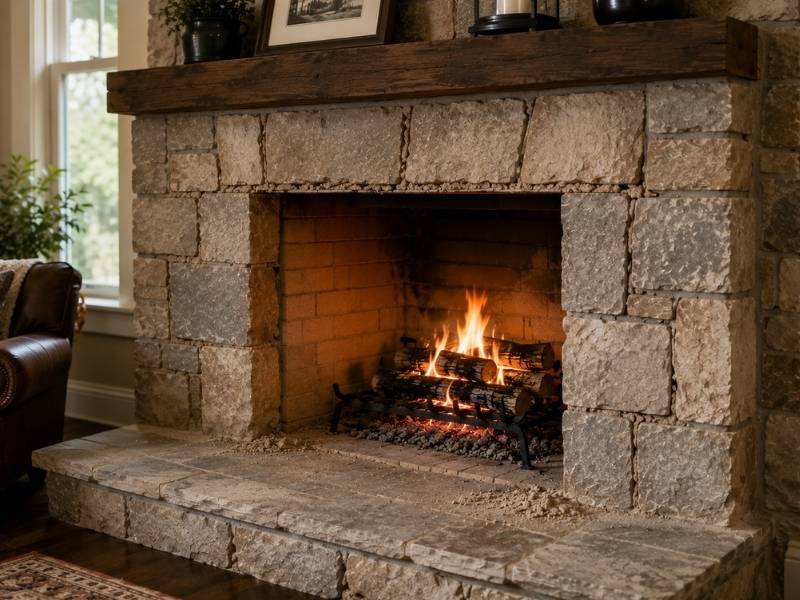
Stone fireplace joints naturally experience small amounts of movement as the masonry heats up during use and cools afterward. Over time, repeated heating and cooling cycles can contribute to normal wear in mortar joints, particularly when combined with age, moisture, or other environmental conditions. Understanding how these changes affect a stone fireplace helps homeowners recognize the difference between expected movement and signs that may require maintenance or repair. Regular evaluation of the masonry and mortar can help identify developing issues before they become more significant.
Heat Moves Every Part of the Assembly
Stone, mortar and firebrick all expand when they get hot, but they don’t expand at the same rate. Dense stone reacts slowly and modestly, mortar responds more readily, and firebrick sitting directly in the flame path sees far higher temperatures than anything else in the structure. Those differences create tiny amounts of shear at every joint, since two materials bonded together are trying to change size by slightly different amounts.
A single fire produces movement measured in fractions of a millimeter, which nobody notices. The effect comes from repetition. Each heating and cooling cycle works the bond between stone and mortar a little, and over many seasons the weakest joints begin to loosen. The firebox and the area immediately above it take the hardest use, since that’s where temperatures climb fastest and drop furthest. Masonry farther from the fire moves less and generally lasts longer. This is why deterioration in a stone fireplace almost always starts near the opening and works outward rather than appearing evenly across the whole face.
Mortar Gives Way Before the Stone Does
Mortar is designed to be the softer, more sacrificial part of a masonry system, and that design choice matters here. A mortar softer than the surrounding stone absorbs movement and wears out gradually, which protects the stone. A mortar harder than the stone forces the stone faces to take the stress instead, and spalled or chipped stone is a far more expensive repair than repointing.
Wear shows up in predictable ways. Joints look recessed or hollow compared to the stone face, small sections crumble when touched, and fine cracks run along the joint line rather than through the stone. Sandy residue collecting on the hearth is a common early clue that joints are breaking down above. Once a joint opens far enough, heat and combustion gases have a route into the masonry behind, and moisture has one too. Repointing at that stage stays a straightforward job. Delaying it lets the deterioration reach deeper courses, where the repair means taking apart and rebuilding rather than raking out and refilling.
Firebox Condition Affects Everything Around It
The firebox does the hardest work in the whole assembly, so its condition shapes how the surrounding stone performs. Firebrick develops hairline cracks from thermal cycling, and refractory mortar between those bricks erodes from repeated heating combined with the acidic residue that combustion leaves behind. Neither problem looks dramatic at first.
The consequences reach past the firebox itself. Gaps in the firebrick let heat contact the structural masonry that was never meant to take direct flame, and that heat accelerates joint deterioration in the stonework outside. Smoke and gases entering through those gaps can stain adjacent walls and carry moisture into the assembly. Owners sometimes notice performance changes first, such as fires that draw poorly or heat felt on the wall beside the fireplace. Because much of this sits out of easy view, a visual check of the face tells you almost nothing about the firebox. Looking inside, with a light and a mirror or a camera, belongs in any honest evaluation of a fireplace’s condition.
Water Makes Seasonal Movement Worse
Moisture in masonry changes the whole picture, because wet mortar behaves differently than dry mortar under temperature swings. Water absorbed into joints expands when it freezes, and that expansion pushes mortar apart from the inside. A joint already loosened by years of heating cycles takes far more damage from that than a sound one would.
The water usually arrives from above rather than through the face. A cracked chimney crown, a missing or damaged cap, failed flashing at the roof line, or open joints on an exterior chimney all let rain into the system. That water travels down through the masonry, and it carries dissolved salts with it that leave white deposits on the stone as it evaporates. Those deposits often show up as the first visible sign of a moisture path nobody knew existed. Controlling the water at its entry point does more for the long term condition of the joints than any repair to the joints themselves, so leaks get fixed before repointing starts.
Regular Inspections Catch Change While It’s Small
The value of periodic inspection comes from comparison. One look tells you the current condition, and repeated looks tell you whether something is moving. A joint that appeared slightly recessed two years ago and now shows a quarter inch of loss is a different situation than one that hasn’t changed.
Most homeowners get good results from an annual check before burning season, with a professional inspection at a longer interval or whenever something changes. A chimney professional evaluates the flue liner, the crown, the cap, the flashing, the firebox and the smoke chamber, which covers the parts an owner can’t reasonably see. Between those visits, watching for sandy debris on the hearth, loose joints near the opening, white staining on the stone, water marks on nearby walls and any change in how the fireplace draws will flag most developing problems. Repairs made at that stage stay modest. Repairs made after a season of ignoring the signs rarely do.
