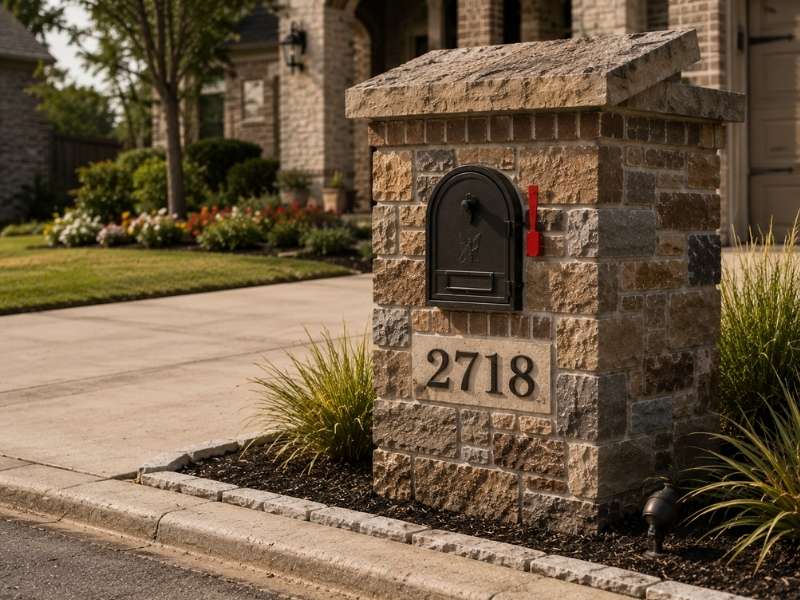
Masonry mailbox design should balance appearance with everyday function. The mailbox opening needs to accommodate typical mail, the door should operate without interference from the surrounding masonry, address numbers should remain easy to read from the street, and the installation should provide convenient access for both mail delivery and property owners. Considering these practical details before construction begins helps create a masonry mailbox that complements the home while remaining functional and easier to use over time.
Size the Opening Around Real Mail
The mailbox insert determines the opening, and that order matters. Choose the box first, then build the masonry to fit it, because trying to force a standard box into an opening someone framed by eye produces gaps, binding doors and mortar chipped away in frustration. Most homeowners underestimate what arrives in a week, since catalogs, padded envelopes and small parcels take up considerably more room than letters do.
Door clearance is the detail most often missed. A door needs to open fully without striking the stone around it, and the swing needs clear space in front. Stone or brick set flush to the door edges leaves no tolerance for the slight settling every masonry structure experiences, so a small reveal around the box saves trouble later. Depth deserves thought as well, since a box recessed too far into thick masonry puts mail out of comfortable reach. Building a sleeve or frame into the masonry rather than mortaring directly against the box also makes replacement possible when the insert eventually wears out.
Keep the Address Numbers Readable
Address numbers do more than help the mail arrive. Emergency responders looking for a house at night depend on them, and a number hidden behind a shrub costs time that matters. Numbers should read clearly from a vehicle moving at normal street speed, from both directions, in daylight and in the dark.
Several things affect whether they actually do:
- height, since numbers set too low disappear behind parked cars and snow banks
- contrast between the numbers and the masonry behind them
- character size, with four inches generally treated as a practical minimum
- lighting, either a small fixture or numbers with a reflective finish
- landscaping that will grow to cover the face within a season or two
- orientation, so numbers face the street rather than the driveway
Mounting method matters too. Numbers pinned into mortar joints hold better than numbers glued to a stone face, and metal characters set with proper anchors survive weather that adhesive alone won’t.
Place the Footing Where It Can Do Its Job
Footing placement involves more than depth. Position relative to the curb and the driveway decides whether the mailbox stays usable and intact, since a structure set too close to the pavement edge gets clipped by delivery trucks, snow equipment and drivers cutting a turn short. Setting it back a reasonable distance while keeping mail within arm’s reach from a vehicle window takes a little measuring, and postal guidance on height and setback gives a starting point worth confirming locally.
Ground conditions under the footing shape how long the structure stays plumb. Soil that holds water, ground disturbed during driveway construction, and areas that receive concentrated runoff all deserve attention before concrete goes in. A compacted base, a footing sized for the mass above it and depth appropriate for local conditions cost very little during construction. Utility locates belong in this stage too, since irrigation lines, low voltage lighting and buried services frequently run along the front of a property exactly where the footing wants to go.
Leave Room for People to Use It
A mailbox sits at the meeting point of a driveway, a sidewalk, a lawn and a street, and all of those affect the approach. A carrier working from a vehicle needs a clear path to the door without leaning over landscaping or stepping into a planting bed. A homeowner walking out for the mail wants a surface that stays firm underfoot rather than turning to mud after rain.
Nearby features can quietly make the mailbox awkward. Gates that swing into the approach, decorative boulders, irrigation heads, mature plantings and driveway columns all reduce usable space around the structure. Steep grade at the curb causes similar trouble, since standing on a slope while sorting mail is nobody’s preference. Placing the structure where it clears these obstacles, and leaving a small paved or stabilized area at the base, makes the difference between a mailbox people use easily and one they work around. Thinking through winter conditions helps too, because whatever gets piled at the curb ends up in that same space.
Check Neighborhood Standards Before Building
Communities with masonry mailboxes often established those standards deliberately, and the rules usually outlive the original developer. Requirements can cover stone or brick type, mortar color, overall height and width, cap style, address number format, lighting and exactly where the structure may sit relative to the property line.
Reading the governing documents before selecting materials avoids an expensive correction. Many associations require written approval before construction and want a description of materials and dimensions submitted in advance, and a mailbox built without that approval can be ordered modified at the owner’s cost. Local rules sometimes apply as well, particularly regarding how close a solid structure may sit to a public road, since a heavy masonry object at the pavement edge raises safety questions in some jurisdictions. Gathering both sets of requirements early lets a mason build once and build correctly.
