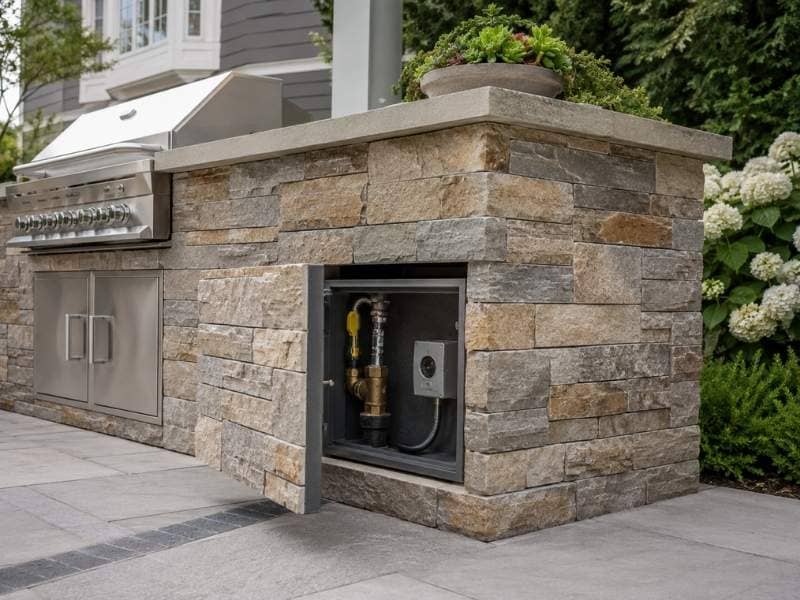
A well-built outdoor feature often hides a working system inside it. Behind the stone of a grill island, a fountain, or a fire feature sit valves, wires, and connections that someone will need to reach one day. A good stone mason plans for that day before the first stone goes down. When access gets ignored, the fix later means tearing into finished masonry to reach a shutoff or a box. Building the access in from the start keeps the feature good-looking and easy to service for years to come.
Locate Every Service Point Before Design Begins
You can’t build around something you haven’t mapped. Valves, cleanouts, electrical boxes, irrigation controls, and gas connections all need to be found and marked before the design is set. Each one is a spot a person will have to reach again someday. Knowing where they sit shapes the whole layout of the feature from the start.
These service points can change the size, position, and shape of the masonry more than people expect. A valve that has to stay reachable might shift a wall a few inches or determine where an opening goes. A cleanout buried under a solid stone base becomes a major problem the first time a drain backs up. A gas connection sealed behind finished stone can force a full teardown for a repair that should have taken minutes. Planning these details early allows professional masonry services to design the feature around real access needs instead of running into costly problems halfway through construction.
Access Panels Should Follow the Stone Pattern
An access point doesn’t have to break up the look of a feature. Framed access doors, removable faced panels, coordinated covers, and lift-off caps can all carry the same stone as the surface around them. Done well, the opening reads as part of the pattern rather than a patch stuck on top of it. The eye slides right past it without stopping.
The key is planning the panel as part of the design, not adding it once the stone is up. A panel worked in from the start lines up with the coursing and matches the joints around it. One cut in later almost always looks like an afterthought, with mismatched edges and a frame that fights the surrounding pattern. When the access piece gets the same care as the rest of the face, it hides in plain sight while still opening the moment someone needs it. That balance between looks and function is the whole point of doing it early.
Leave Room to Reach and Repair
An access point only helps if a person can actually use it. Utilities packed in too tight leave no room for a hand, a tool, or a replacement part. A shutoff you can see but can’t turn is nearly as useless as one you can’t reach at all. Space is what makes access real rather than just a nice idea.
Planning that space means thinking about the whole job someone might do there. A valve needs room to operate, not just room to look at. Routine maintenance, inspection, and swapping out worn equipment all take working clearance around the part. A mason who leaves enough space saves the next person from cutting into good stone to finish a simple repair. That room costs almost nothing to plan into the design and a real fortune to carve back in after the fact.
Openings Hide Best Along Design Breaks
Where an opening sits decides how much it stands out. An access point dropped in the middle of a clean stone face pulls the eye straight to it. Placed at a natural break in the design, that same opening nearly disappears. Smart positioning does most of the work of hiding it.
Corners, cabinet doors, material transitions, seating divisions, and shifts in the stone pattern all make good homes for an opening. These spots already interrupt the surface, so a panel there blends into a break the eye is expecting anyway. A cover that lines up with a cabinet door looks like part of the cabinetry. A panel set at a change in material reads as part of that transition rather than a separate feature. Lining the opening up with an intentional break keeps it fully usable while making it far harder to spot.
Coordinate With the Right Trade First
Different systems come with different rules, and a mason isn’t the one who sets them. Plumbing, electrical, gas, irrigation, and mechanical parts each carry their own needs for clearance, venting, labeling, and access. Building stone around a service point without checking those needs first can trap a component that was supposed to stay reachable or vented.
A quick coordination step with the right trade heads that off:
- Plumbing needs room to work shutoffs and clear cleanouts
- Electrical boxes need code clearance and covers that stay reachable
- Gas connections need proper ventilation and an accessible shutoff
- Irrigation controls need access to valves and wiring
- Mechanical equipment may need airflow and space for service
Checking with the trade before the masonry closes in means the stone works with the system instead of against it. The mason builds once, the utility stays safe and serviceable, and nobody has to reopen a finished feature to fix a detail that a short conversation would have solved. That coordination is what separates a feature that looks good on day one from one that still works twenty years down the line.
