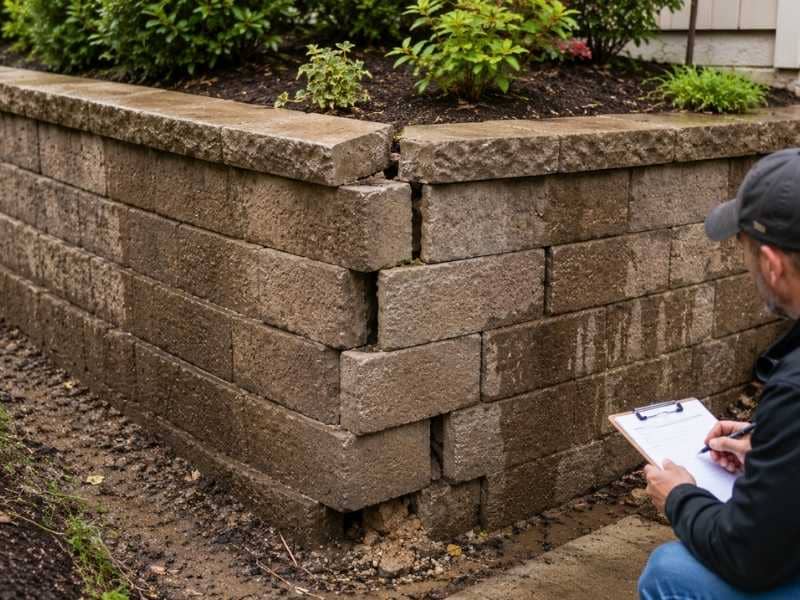
A retaining wall holds back soil day after day, and the corners take some of the hardest strain. When two wall sections meet, they carry pressure coming from two directions at once. That’s why trouble often shows up at a corner before it appears anywhere else along the run. Watching those meeting points closely can catch a small problem while it’s still cheap and simple to fix. The signs below show what corner movement looks like and when it turns serious enough to call a professional.
Separation Where Two Sections Meet
The place where two wall sections join is a natural weak point. When that joint starts pulling apart, you’ll usually notice it there first. Widening gaps, cracked joints, shifted caps, and blocks that no longer line up can all point to sections moving in different directions. These signs mean the two runs aren’t holding together the way they were built to.
Not every crack spells trouble. A thin surface crack can come from normal curing or minor settling and never grow into anything real. The changes worth taking seriously are the ones that keep moving. A gap that widens over several months, a cap that keeps creeping out of place, or a joint that opens a little more each season shows movement that hasn’t stopped. A crack you can watch grow is a very different thing from one that’s held steady for years. When a change keeps building on itself, it earns a closer look instead of a quick smear of patch material.
Compare How Each Face Lines Up
A corner ties two wall faces together, and they don’t always move as a pair. One side might lean outward while the other holds its line. One face can bulge or twist while its neighbor stays flat. Checking both faces against each other tells you far more than studying a single side on its own.
The trick is to look from more than one position. Standing straight in front of a wall hides a lot, since a slow lean or a gentle bulge barely registers head-on. Step off to the side, sight down the length of each face, and study the corner from a few angles and distances. Movement that’s invisible from the front often jumps out the moment you view the wall along its length. Comparing the two faces this way shows which side is doing the pushing and which one is starting to give. That difference usually points straight toward where the real problem sits.
Soil Pressure Builds Up at the Return
Every retaining wall pushes back against the soil behind it, and that pressure isn’t equal everywhere. Near a corner or a wall return, force can stack up from two directions at once. Anything resting on the retained soil adds to the load. The more weight sitting above the wall, the harder the corner has to work to hold everything in place.
A lot of ordinary features raise that pressure without anyone giving it a thought. A raised planting bed full of wet soil adds real weight. A driveway, a shed, a patio, or a stack of stored materials near the top all press down on the ground the wall is holding. A steep grade change behind the corner makes the load heavier still. When you notice heavy features close to a wall return that’s already showing movement, that extra pressure is often part of the cause. Taking some of that load off, by moving stored material or reshaping a bed, can ease the strain, though a corner that’s already shifting may need more than that to set right.
Trace Water Trouble at the Joint
Water likes to gather where two wall sections meet. A corner can funnel runoff toward one narrow spot, and if the drainage there isn’t keeping up, moisture builds in the soil behind the wall. Wet soil weighs more and pushes harder, so a drainage problem at a corner can be the very thing driving the movement you see.
The clues are usually right there once you know what to look for. Staining down the face, soil that stays damp long after a rain, and small ruts of erosion all hint at water pooling nearby. Sediment washed out at the base, a drainage outlet that sits plugged, or backfill carried off by runoff tell the same story. When these signs cluster around a corner that’s moving, water is likely feeding the problem. Clearing a blocked outlet or fixing where the runoff lands can slow it down. Steady washout next to a leaning corner, though, is a clear sign to get a proper assessment before the damage spreads.
Know When a Professional Should Step In
A careful look at a corner tells you a great deal, yet some situations call for trained eyes. A professional inspection weighs the wall height, how far the wall has visibly moved, the drainage around it, any soil that’s washed away, the loads sitting above, and any hint of uneven settling underneath. All of those factors read together give a much clearer picture than any single clue on its own.
The plain truth is that the exact cause often can’t be judged from the surface. What looks like a simple drainage fix can trace back to a failing footing or soil shifting well below the blocks. Serious warning signs may require professional retaining wall repair, not a hopeful guess or a temporary surface fix. A wall leaning noticeably, a face bulging outward, cracks that keep widening, or movement that just won’t settle all belong in that group. When those turn up at a corner, an expert can find the real cause and plan a repair that holds, rather than a cover-up that looks fine right until the next heavy rain.
