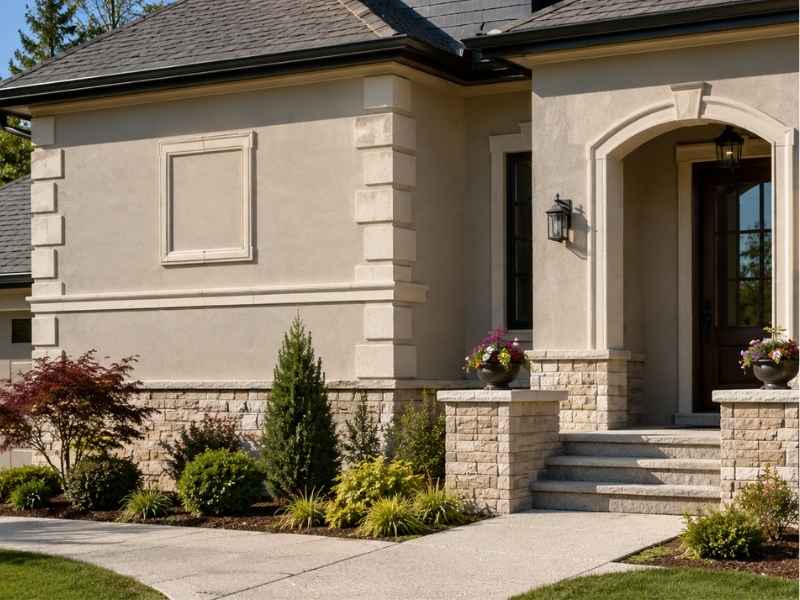
Not every masonry project means rebuilding a wall. Many homeowners get great results from masonry services that focus only on style, not structure. These features get added onto a wall that’s already there. They give it more character without touching the framework holding the house up. A plain wall can go from flat and forgettable to detailed and sharp with the right touches. Best of all, none of this needs structural changes. It’s about adding style on top of a wall that’s already doing its job.
Add Masonry Bands to Break Up Large Exterior Wall Areas
A big, flat wall can look plain no matter how nice the material is. A narrow, horizontal masonry band gives that wall a visual break. It splits the wall into sections instead of leaving one long, blank surface.
Placement matters a lot here. A band that lines up with a floor level, a window line, or another marker looks planned. One placed at a random height looks like an afterthought. This isn’t about the broader brick patterns already used across a home. It’s a narrow, specific detail added just to break up scale and add interest.
Use Masonry Quoins to Give Exterior Corners More Definition
Quoins are the decorative blocks placed at the outside corners of a building. They do a lot for a home’s overall look. Their size, how far they stick out from the wall, and how they’re spaced all shape how much depth they add to a corner.
None of this needs structural changes or a full decorative stone project. Quoins sit on top of the existing wall as a finishing touch. Done with the right proportions, they can make a plain corner look far more sharp. That gives the whole exterior a stronger, more defined edge.
Frame Entry Openings With Non-Structural Masonry Trim
Trimming around a door, or a set-back entry, can make that spot feel far more finished. This is purely a style choice, not a structural one. It’s meant to frame the entrance and pull the eye toward it, nothing more.
Proportion matters most here. Trim that’s too thick or too thin next to the door throws off the whole look. Getting the end points right, where the trim starts and stops, also keeps the detail looking clean instead of messy. This is strictly about outside framing, not structural beams or brick repair around windows.
Finish Wall Tops and Ledges With Decorative Masonry Caps
Low walls, porch edges, and similar features often look unfinished without a proper cap on top. A decorative cap gives that top edge a clean, complete look instead of leaving it flat or rough.
Getting the size, thickness, and lineup right makes the cap look like it belongs there, not like it was tacked on later. This is separate from retaining walls or mailbox posts, which have their own design needs. Here, the goal is simply finishing off a small wall or ledge with a detail that looks planned.
Introduce Recessed Masonry Panels for Subtle Facade Depth
Sometimes the best style move is a shallow, sunken section built right into the wall. These panels create shadow lines that shift throughout the day as the sun moves. That adds depth to a wall without changing its actual structure.
This works best used here and there, not scattered across every open surface. A large blank wall might do well with one or two of these panels, sized and placed to relate to nearby windows, doors, or other lines on the house. Used with care, recessed panels add real interest without fighting the rest of the home’s look.
Frequently Asked Questions
What are examples of non-structural decorative masonry features?
Masonry bands, quoins, decorative surrounds, caps, and shallow recessed panels are common examples. Each one is mainly about looks, not about holding up the building.
Can decorative masonry be added without rebuilding an exterior wall?
Often, yes. Many features can go on as finishes over an existing wall. Still, the wall’s condition, how the new piece attaches, its weight, and other project details need a check first.
What is the difference between decorative masonry and structural masonry?
Structural masonry helps carry the building’s weight. Decorative masonry is mainly for looks, though it still needs to be put in and supported the right way.
How do homeowners keep decorative masonry from looking excessive?
Sticking to matching sizes helps a lot. Using a detail here and there, not everywhere, and tying each feature to lines already on the house keeps the look calm instead of busy.
When should decorative masonry details be planned?
During the design or remodeling planning stage, ideally. Picking sizes, backing, and nearby finishes before work starts makes the whole process go a lot smoother.
