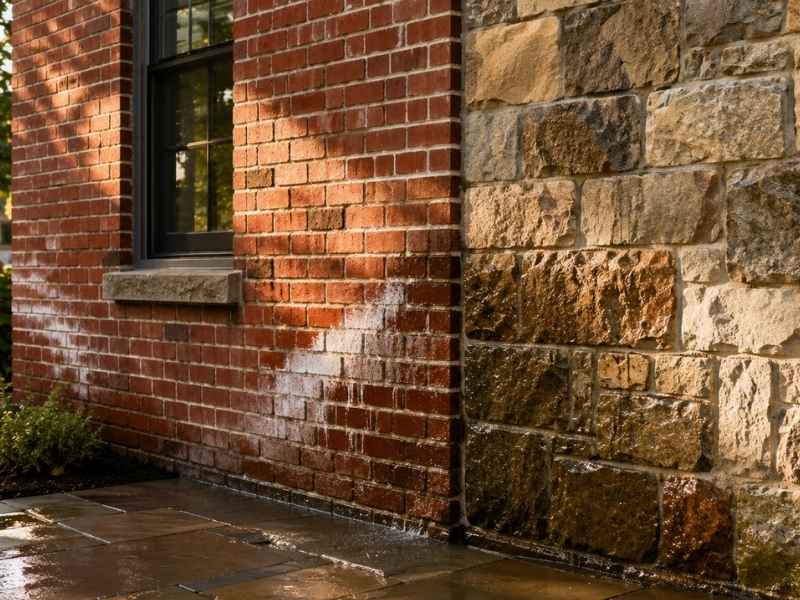
Brick and stone look like they belong to the same family. In some ways, they do. But masonry materials don’t all act the same way once they’re outside facing real weather. One surface might dry fast after rain while another stays damp and dark for hours. One might feel cool to the touch in full sun while the wall right next to it feels hot. These differences aren’t random. They come down to what the material actually is, down to its structure and makeup. Knowing this helps homeowners understand why two parts of the same house can age so differently.
Compare How Brick and Natural Stone Absorb and Release Moisture
Brick and natural stone shouldn’t be expected to handle water the same way. Each one has its own pore structure, and that structure controls how much water gets absorbed and how fast it dries out again. Even different types of natural stone can behave differently from each other.
This is why testing matters so much for natural stone. Absorption varies by stone type, sometimes by a lot. A homeowner might notice one section of a wall darken after rain while a stone accent nearby barely changes color at all. That’s not a flaw. It’s just how these specific materials handle moisture differently.
Understand Why Brick and Stone Heat Up Differently in Direct Sun
Stand near a brick wall on a hot day, then walk over to a stone one. They likely won’t feel the same. Density, color, surface texture, and overall makeup all play a part in how much heat a masonry surface picks up and holds onto.
This isn’t about fireplaces or firebrick. It’s about how ordinary exterior brick and stone behave under the sun over the course of a day. A darker, denser surface tends to hold more heat than a lighter, more textured one. That difference is easy to feel just by touching the wall in the afternoon.
Watch How Repeated Wet-and-Dry Cycles Change Each Material
Rain falls, then the sun comes out and dries things off. That cycle repeats constantly outside, and brick and stone don’t always respond to it the same way over time. Some surfaces develop small mineral deposits. Others show gradual, uneven changes in color across the surface.
These changes usually aren’t a sign of damage. They’re just what happens when a material goes through the same wet-and-dry pattern year after year. Watching for these small shifts helps homeowners understand what’s normal weathering and what might be worth a closer look.
Expect Natural Stone to Weather Less Uniformly Than Manufactured Brick
Manufactured brick starts out fairly consistent. It’s made under controlled conditions, so most pieces in a batch share similar properties from the start. Natural stone works differently. Its mineral makeup varies from piece to piece, since it comes straight from the earth rather than a factory.
That variation shows up over time. Some stone pieces may weather or oxidize a little differently than the ones right next to them, especially as their minerals slowly react to years of sun and moisture. This kind of uneven change doesn’t mean the stone is failing. It’s simply part of what makes natural stone, well, natural.
Use Material-Specific Performance Data When Choosing Brick and Stone
Not every brick behaves like every other brick, and the same goes for stone. Treating all masonry as interchangeable skips over real differences that matter once the material is actually outside facing the elements.
Absorption rates, density, resistance to environmental exposure, and how a material handles thermal and moisture cycling are all recognized factors when evaluating natural stone specifically. Looking at the properties of the actual product being considered, rather than assuming one type of stone or brick behaves like another, gives homeowners and designers a much clearer picture of what to expect over the years ahead.
Frequently Asked Questions
Does brick absorb moisture differently from natural stone?
Absorption depends on the specific brick or stone product involved. It’s not accurate to assume one entire material category always absorbs more water than the other.
Why can stone change color after it gets wet?
Moisture can temporarily deepen the appearance of some stone types. Over longer periods, mineral composition can also influence how a stone’s color or texture gradually changes.
Do dark brick and stone surfaces get hotter in direct sunlight?
Often, yes, but not always in the same way. Surface color, texture, orientation, and material properties all affect heat gain, so surfaces that look similar may not behave identically in the sun.
Does natural stone always weather evenly?
No. Natural stone has built-in mineral and texture variation, which can lead individual pieces to change differently over years of exposure. Some stone types are specifically evaluated for how they handle environmental and thermal cycling.
Should homeowners compare technical data before choosing brick or stone?
It helps, especially for masonry that will face a lot of moisture, sun, or temperature swings. Product-specific information gives a clearer picture than choosing based on appearance alone.
